Why Tankless Water Heaters Need Altitude Derating Above 6,000 Feet
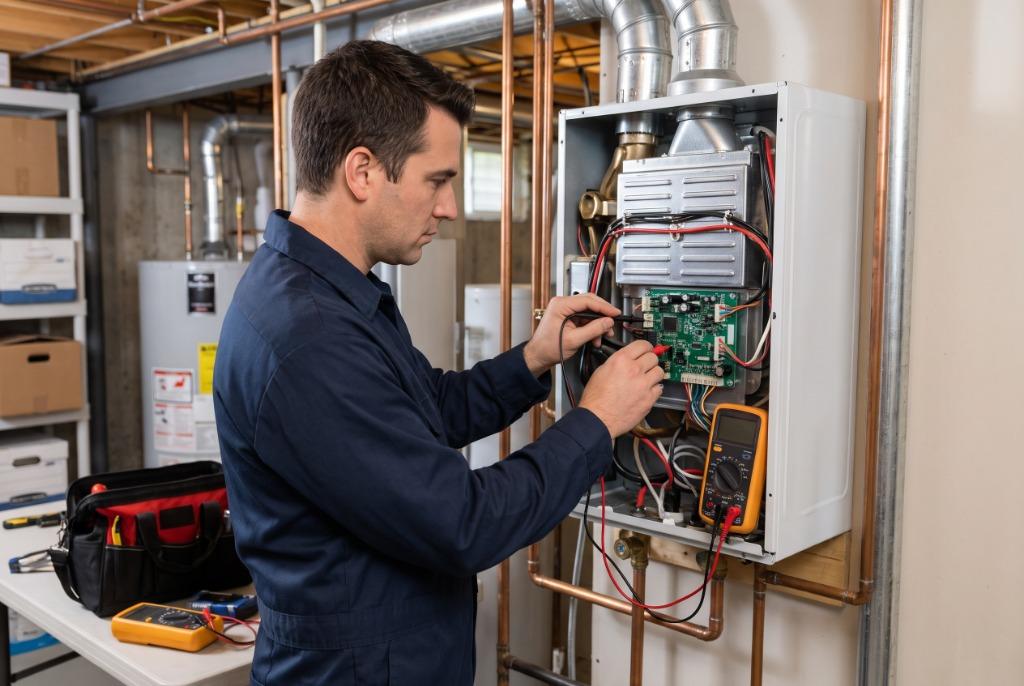
- Atmospheric pressure at 6,000+ ft reduces available oxygen by 20% or more.
- Standard fuel code requires up to a 16% to 26% derating in effective heating BTUs.
- Uncalibrated units suffer from heavy soot buildup, carbon monoxide, and premature failure.
- Modern units require precise electronic DIP switch and fan speed calibration upon installation.
One of the most frequent mistakes made by out-of-state contractors or inexperienced plumbers in Colorado is treating tankless water heater specifications as universal. A 199,000 BTU unit installed at sea level in San Diego delivers vastly different performance than that exact same model installed at 6,035 feet in Colorado Springs—or at 8,465 feet in Woodland Park. Understanding high-altitude derating is the key to preventing soot-choked burners and perpetual lukewarm showers.
The Physics of High Elevation Combustion
Combustion of natural gas or liquid propane is an exact stoichiometric chemical reaction. For natural gas (methane), complete combustion requires approximately 10 cubic feet of atmospheric air for every 1 cubic foot of gas burned. In return, the reaction produces heat, carbon dioxide, and water vapor.
As elevation increases, atmospheric pressure drops. In Colorado Springs, atmospheric pressure is roughly 11.8 psi compared to 14.7 psi at sea level. The air is less dense, meaning every cubic foot drawn into the water heater's blower fan contains roughly 20% fewer oxygen molecules. If the gas flow is not proportionally derated or the blower fan speed is not electronically boosted, there will not be enough oxygen to burn the fuel completely.
The National Standard: 4% Derate per 1,000 Feet
The National Fuel Gas Code (NFPA 54 / ANSI Z223.1) mandates that gas-fired appliances without electronic self-compensating gas valves must be derated by 4% for every 1,000 feet of elevation above 2,000 feet.
Let's look at the math for Colorado Springs (approx. 6,000 ft): (6,000 - 2,000) / 1,000 = 4 intervals. 4 intervals x 4% = 16% total reduction in effective heating capacity. That means a nominal 199,000 BTU tankless water heater will only generate approximately 167,000 usable BTUs of heating power.
In Woodland Park or Divide (at 8,500 ft), the derating factor approaches 26%, reducing a 199,000 BTU heater to roughly 147,000 BTUs!
What Happens When a Tankless Unit Is Not Calibrated for Altitude?
When a contractor installs a tankless heater straight out of the box without adjusting altitude DIP switches or gas manifold pressure orifices, serious complications arise:
1. Heavy Carbon Soot Buildup: Incomplete combustion produces thick black soot that rapidly blankets the exterior fins of copper and stainless steel heat exchangers. Within 12 to 18 months, heat transfer is severely restricted.
2. Carbon Monoxide Generation: Incomplete combustion spikes toxic carbon monoxide (CO) production in the exhaust flue, presenting a serious hazard if venting connections become compromised.
3. Heat Exchanger Burn-Through: Unbalanced flame geometry creates localized hot spots exceeding 1,400°F on internal metal tubes, causing metal fatigue, pinholes, and costly water leaks.
4. Erratic Flame Sense Errors: Sensor rods fail to detect erratic, dancing flames, causing constant lockouts and error code flashing.
How Modern Electronic Units Overcome High Altitude
Premium modern manufacturers like Navien, Rinnai, and Noritz have engineered advanced digital solutions. Rather than physically drilling smaller brass gas orifices, these units utilize modulated DC combustion blowers paired with microprocessor controls.
By setting the high-altitude DIP switches or configuring the installer menu, the technician instructs the onboard computer to increase the blower RPM curve by 15% to 25%. This forces additional air volume into the combustion chamber, restoring the correct oxygen-to-gas ratio and allowing the unit to burn cleanly with near-zero soot.
Conclusion & Professional Recommendations
Never assume your tankless water heater is operating at factory peak without professional altitude verification. If your heater rumbles, smells like soot, or produces tepid water in winter, contact our Colorado Springs technicians for an altitude combustion audit.
Related Services & Local Coverage:
Need Diagnostic Help on Your Tankless System?
Call our local Colorado Springs dispatch line. No waiting for email or form replies—speak directly with an on-call technician.
What Callers Should Have Ready For Fast Diagnosis:
Continue Reading
View All 10 Guides →Navien Error Code 003 vs 012: Ignition Troubleshooting in Colorado Springs
Waking up to cold water and a flashing E003 or E012 error on your Navien tankless display? Here is an expert breakdown of why these ignition faults happen at high elevation and how to resolve them safely.
Colorado Springs Hard Water Guide: How Mineral Scale Destroys Heat Exchangers
Discover why Colorado Springs water chemistry accelerates heat exchanger calcification, how to recognize early signs of scale restriction, and the best preventative solutions.
Winter Freeze Protection: Preventing Frozen Condensate Lines in Pikes Peak Region
When Arctic blizzards hit Colorado Springs, frozen tankless condensate lines can instantly shut down your heat. Here is how to winterize your system and fix frozen lines fast.