Colorado Springs Hard Water Guide: How Mineral Scale Destroys Heat Exchangers
- Heating causes dissolved calcium bicarbonate to turn into solid limestone scale.
- Even 1/32 of an inch of scale insulates heat transfer and overheats heat exchangers.
- Falcon and Fountain well water has significantly higher hardness than central city water.
- Annual professional descaling preserves your 15-year manufacturer warranty.
Colorado Springs is famous for its crisp mountain water sourced from the continental divide and Pikes Peak watersheds. However, as snowmelt flows through granite rock formations, limestone deposits, and deep underground alluvial aquifers, it dissolves substantial quantities of calcium and magnesium minerals. When this water enters the microscopic passages of a tankless water heater, those minerals undergo a destructive chemical transformation.
The Chemistry of Scale: How Heat Triggers Crystallization
In cold tap water, calcium bicarbonate remains completely dissolved and invisible in solution. However, when water flows past a tankless heat exchanger operating at temperatures between 140°F and 180°F, heat drives off dissolved carbon dioxide.
This chemical shift converts soluble calcium bicarbonate into insoluble calcium carbonate (calcite)—the exact mineral compound that makes up limestone and concrete. The calcite precipitates out of the water and bonds aggressively to hot copper and stainless steel heat exchanger tubing, forming a dense, rock-hard insulating barrier.
Why Tankless Units Are Far More Vulnerable Than Old Tank Heaters
In a traditional 50-gallon tank water heater, water moves very slowly, and mineral sediment settles loosely on the bottom of the tank floor. While inefficient, the tank continues to work for years with sediment resting on the bottom.
Tankless water heaters, by design, do not have a reservoir. Instead, water is forced through narrow, high-velocity heating coils measuring less than 1/2 inch in internal diameter. When just 1/32 of an inch of scale forms on these narrow walls, the consequences are immediate:
1. Severe Thermal Insulation: Calcium carbonate has an insulation value comparable to fiberglass. The burner flame must burn much hotter just to push heat through the stone barrier into the water.
2. Extreme Overheating: Trapped heat cannot escape into the water stream, causing the metal tubing to exceed 1,000°F. This thermal stress cracks welds and triggers emergency overheat fault codes (such as Navien E016 or Rinnai Code 14).
3. Velocity Choking: Scale constriction chokes water pressure, causing low shower volume and tripping flow-activation reed switches.
Regional Water Hardness Breakdown Across the Pikes Peak Region
Water hardness is not identical throughout our service area. Here is what homeowners face:
• Central & West Colorado Springs (CSU Municipal): Moderately hard (roughly 80 to 120 mg/L or 5 to 7 grains per gallon). Manageable with strict annual descaling.
• Fountain Valley & Widefield: Harder alluvial aquifer supplies (130 to 190 mg/L or 8 to 11 grains per gallon). Scale begins constricting water flow within 12 months.
• Falcon, Peyton & Black Forest: Deep bedrock private wells (Arapahoe & Denver Basin) frequently test at 180 to 260+ mg/L (11 to 15+ grains per gallon). Without whole-home conditioning, unserviced tankless heat exchangers can fail catastrophically in under 3 years.
The Solution: Annual Professional Chemical Descaling
Preventing scale damage requires two primary strategies:
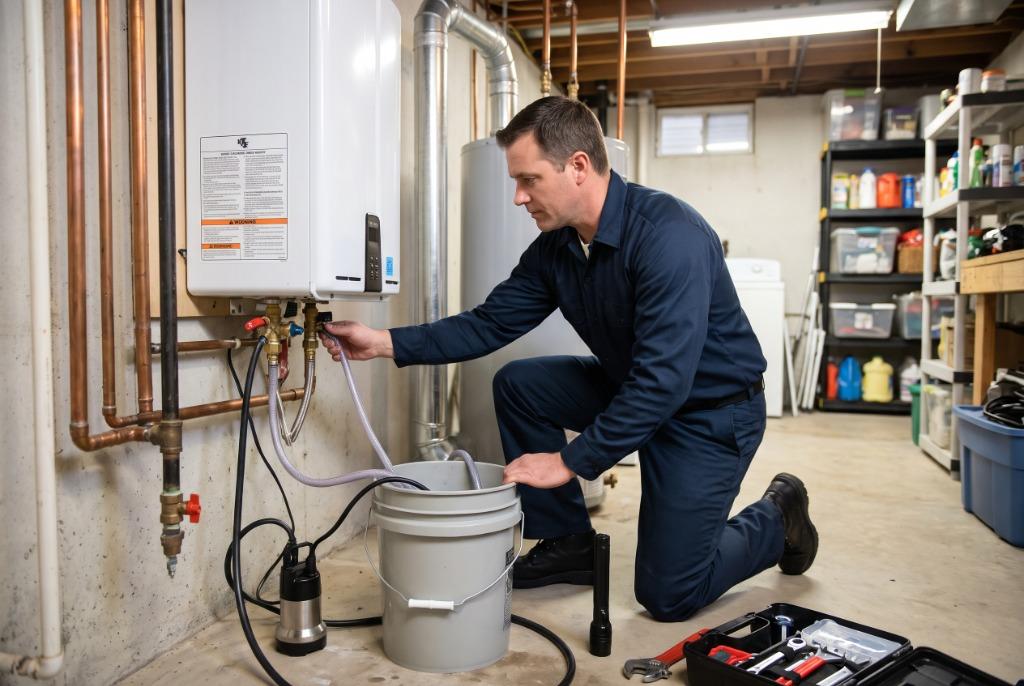
First, professional chemical descaling every 12 months. Using heavy-duty circulation pumps and virgin food-grade citric or sulfamic descaling solutions, our technicians dissolve 100% of accumulated mineral crust without corroding internal copper and stainless alloys.
Second, consider adding an inline polyphosphate scale inhibitor or catalytic anti-scale water treatment cartridge onto your cold water supply. These systems sequester calcium ions, preventing them from bonding to hot metal surfaces.
Conclusion & Professional Recommendations
Do not let Colorado Springs hard water shorten the life of your investment. If your water heater makes rattling noises or takes longer to warm up, book a professional descaling service today.
Related Services & Local Coverage:
Need Diagnostic Help on Your Tankless System?
Call our local Colorado Springs dispatch line. No waiting for email or form replies—speak directly with an on-call technician.
What Callers Should Have Ready For Fast Diagnosis:
Continue Reading
View All 10 Guides →Navien Error Code 003 vs 012: Ignition Troubleshooting in Colorado Springs
Waking up to cold water and a flashing E003 or E012 error on your Navien tankless display? Here is an expert breakdown of why these ignition faults happen at high elevation and how to resolve them safely.
Why Tankless Water Heaters Need Altitude Derating Above 6,000 Feet
Planning or troubleshooting a tankless water heater along the Colorado Front Range? Learn why atmospheric derating above 6,000 feet changes gas sizing, flow capacity, and combustion safety.
Winter Freeze Protection: Preventing Frozen Condensate Lines in Pikes Peak Region
When Arctic blizzards hit Colorado Springs, frozen tankless condensate lines can instantly shut down your heat. Here is how to winterize your system and fix frozen lines fast.